
Turbulence Defines Oxygen Transfer in MBBR Biofilters
Surface Area Doesn't Equal Usable Capacity in MBBR Systems
When evaluating MBBR bio media for Recirculating Aquaculture Systems (RAS), surface area is almost universally treated as the primary performance metric. Manufacturers frequently highlight impressive values like 500, 800, or even 1000 m²/m³ to demonstrate their product's superiority.
While surface area is undoubtedly important, it is frequently misunderstood and overemphasized. From an engineering perspective, surface area only contributes to treatment capacity if it is effectively and continuously utilized throughout the system's operation.
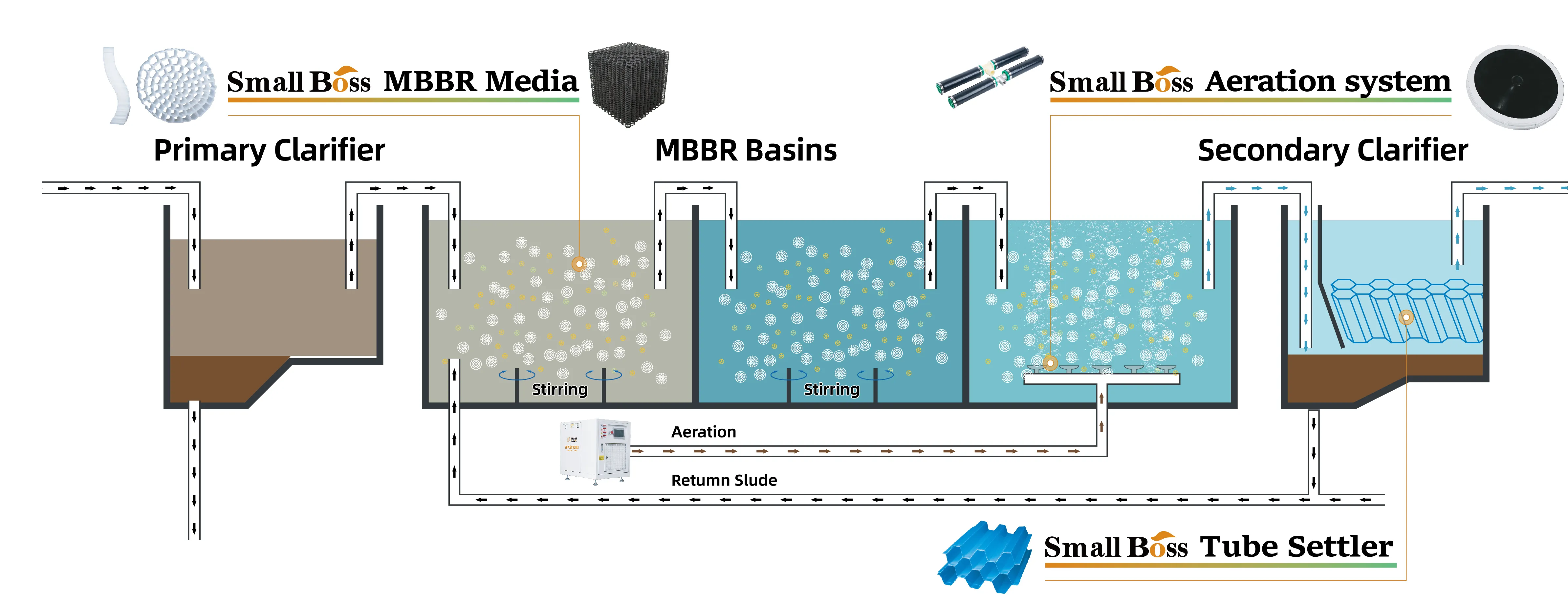
The Critical Concept of "Accessible Surface Area"
For efficient nitrification—the core function of any RAS biofilter—two essential elements must simultaneously reach the biofilm:
- Substrate (primarily ammonia and nitrite)
- Dissolved oxygen (DO)
Therefore, the relevant performance parameter is not total surface area, but the surface area that remains continuously accessible to both substrate and oxygen.
Limitations of High-Density or Micro-Structured Media
Media designs featuring complex internal geometries, micro-pores, or protected cavities can theoretically provide extremely high surface area values. However, in real-world RAS environments, these designs often fail to deliver on their promises due to three fundamental issues:
1. Suspended Solids Accumulation
Over time, fine suspended solids from fish waste and uneaten feed accumulate in the protected internal cavities, blocking water flow and reducing effective surface area.
2. Uneven Biofilm Growth
Biofilm grows thicker in low-flow areas, eventually completely blocking internal passages and turning once-usable surface area into dead zones.
3. Poor Internal Hydrodynamics
Complex internal structures create regions with extremely low flow velocity, where water exchange becomes minimal and mass transfer relies almost entirely on slow diffusion.
Development of Internal Oxygen Limitation
As the system operates, the problems mentioned above lead to a gradual but inevitable decline in performance:
- Oxygen cannot effectively penetrate deep into the media's internal structure
- Internal zones become oxygen-deficient, making them unsuitable for nitrification
- All nitrification activity shifts to the outer surfaces of the media
The result is a significant reduction in effective surface area, even though the physical structure of the media remains unchanged. This explains why many high-surface-area media only achieve 30-50% of their theoretical treatment capacity in long-term operation.
The Mismatch Between Design and Reality
This phenomenon directly explains two common frustrations in RAS design and operation:
- Media with very high nominal surface area does not always deliver higher performance—in some cases, it may even perform worse than media with lower total surface area but better accessibility
- Two systems with identical design loads can perform very differently depending solely on the type of MBBR media selected
In practice, most RAS biofilters operate well below their theoretical capacity due to mass transfer limitations, fouling and clogging, and poor internal hydrodynamics.
A More Realistic Evaluation Approach
Instead of focusing solely on total surface area, engineers and RAS operators should prioritize these critical factors when selecting MBBR media:
| Evaluation Criterion | Why It Matters |
|---|---|
| Open vs. Closed Structure | Open structures allow better water flow and oxygen penetration throughout the media |
| Resistance to Clogging | Media that resists fouling maintains its effective surface area over longer periods |
| Flow-Through Capability | The ability to maintain consistent flow through the media prevents dead zones |
| Long-Term Oxygen Transfer | Stable oxygen transfer ensures consistent nitrification performance |
Engineering Implications for RAS Design
Effective biofilter performance depends on maintaining three essential conditions simultaneously:
- A healthy, active biofilm with the right microbial community
- A continuous and sufficient supply of dissolved oxygen
- Stable hydrodynamic conditions throughout the media bed
This represents a fundamental shift in evaluation criteria—from asking "How much surface area is provided?" to asking "How much surface area remains active over time?"
Conclusion
Surface area is a necessary parameter, but it is not a sufficient one. In MBBR systems, treatment capacity is ultimately determined by how much of that surface remains accessible, active, and well-supplied with oxygen throughout the system's operational life.
When selecting MBBR media for your RAS project, look beyond the impressive surface area numbers and focus on the design features that ensure long-term performance and reliability.
Small Boss: Your Trusted MBBR Media Manufacturer
At Tongxiang Small Boss Special Plastic Products Co., Ltd., we have over 30 years of experience in plastic extrusion technology and MBBR media production. Our high-performance MBBR carriers are specifically designed to maximize accessible surface area and ensure optimal oxygen transfer in RAS systems.
Our MBBR media features:
- Optimized open structure for excellent water flow and oxygen penetration
- Superior resistance to fouling and clogging
- Precision-engineered density (0.95-0.98 g/cm³) for uniform fluidization
- Fast biofilm formation and stable long-term performance
Contact our technical team today to discuss your RAS project requirements and find the perfect MBBR media solution for your needs.


