
A$10 Million for Farm Data Shows What Failed Expansions Are Missing
Read from the outside, Australia's money looks like it belongs to the high-tech end of the industry — sensors, drones, AI, genomic tools — and to have nothing to do with an ordinary farmer's ponds. Yet the project that caught industry attention on 27 October asks something very plain: what happens between the fish, the feed and the water, every day.
Led by James Cook University, this "next-generation tropical aquaculture" research centre runs for five years with total investment of about A$10 million. The Australian Research Council puts in A$4.863 million, and commercial aquaculture companies are part of the consortium. The work covers growth variation, feed efficiency, stress tolerance and disease resilience, with the technology to be tested directly on farms.
When national research money goes into "fish-farm data", the whole industry is being told something: a system stays stable not because of one machine, but because somebody knows what happened each day.
01 | Most farms that fail on expansion lose on the record book first
Many projects are fine at small scale. Add ponds, push density, and ammonia swings, oxygen shortages and falling feed intake all show up together. Rarely is a single unit at fault. Biomass, feed input, make-up water, temperature and treatment capacity are all moving at once, and none of them has been entered on the same load sheet.
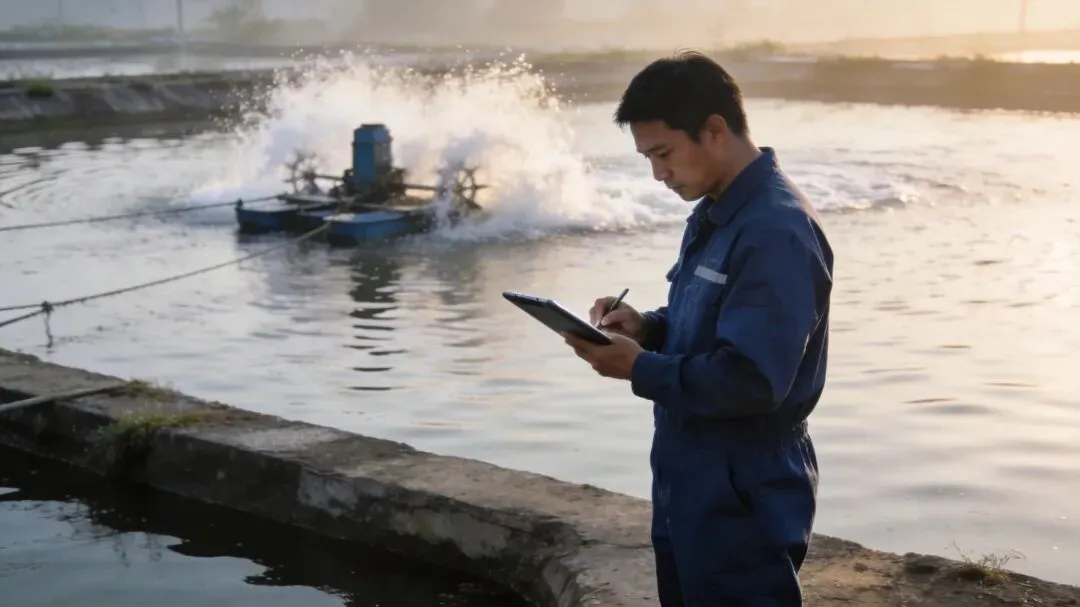
A small or mid-sized farm does not need to copy drones or genomic platforms. The first step is free — keep recording. At the very least, these:
- 1 Water: daily make-up and exchange volume
- 2 Biomass: standing stock and density
- 3 Feed: daily feed input
- 4 Water quality: temperature, dissolved oxygen, pH, ammonia, nitrite
- 5 Events: water changes, medication, mortality and abnormal weather
Records must line up in time and in definition. Otherwise there is no way to separate a one-off event from a persistent one, or a rising load from a falling equipment performance.
02 | The 50% mortality case: water quality is only one of the four links
A second study, published on 27 October, went back over a mass mortality of bighead carp in the aquaculture system of the East Kolkata wetlands in India. It identified an emerging multidrug-resistant opportunistic pathogen, and passive surveillance estimated cumulative mortality at about 50%. The event dates to 2023; the paper appeared only in October 2026.
It would be wrong to compress this into "one water quality parameter killed the fish". The point is that four things must hold at the same time:
- 1 stable water quality
- 2 pathogen diagnosis
- 3 biosecurity
- 4 responsible medication practice
Any one of them left open, and the whole system can be wiped out in a night.
03 | The next stage of farming is not an equipment list, it is load matching
The same water volume carries a completely different pollution load depending on feed intensity and biomass. Size a recirculating or effluent treatment plan on "how many cubic metres" alone, and after expansion it will almost certainly be out of step with the real duty.
The U.S. EPA technical document keeps its wording on MBBR modest: high specific surface area plastic carriers are used to raise the biomass held in a bioreactor. That stabilises the biochemical step. It does not stand in for isolation, disinfection, pathogen testing or responsible medication. When something looks wrong, check dissolved oxygen, temperature, ammonia and nitrite first and keep a sample for pathogen diagnosis, rather than buying more equipment straight away.
04 | Plan, product and service: Small Boss splits it into twelve steps
Tongxiang Small Boss divides the work into three stages and twelve steps, carrying it from planning through to operation:
▍ Planning
- 1 Project requirement discussion
- 2 Water quality and site condition analysis
- 3 MBBR process feasibility assessment
- 4 Process design and media selection
▍ Production and delivery
- 1 Custom MBBR media production
- 2 Aeration, retention and blower system matching
- 3 Product testing and batch quality traceability
- 4 Media charging and system commissioning guidance
▍ Operation support
- 1 Inoculation, biofilm development and start-up guidance
- 2 Operating parameter tracking and optimisation
- 3 Equipment operation and O&M staff training
- 4 Scheduled follow-up and abnormal condition support
What is supplied is not only a batch of media but a water treatment solution that can be implemented, operated and continuously optimised — that is how Small Boss defines "one-stop".
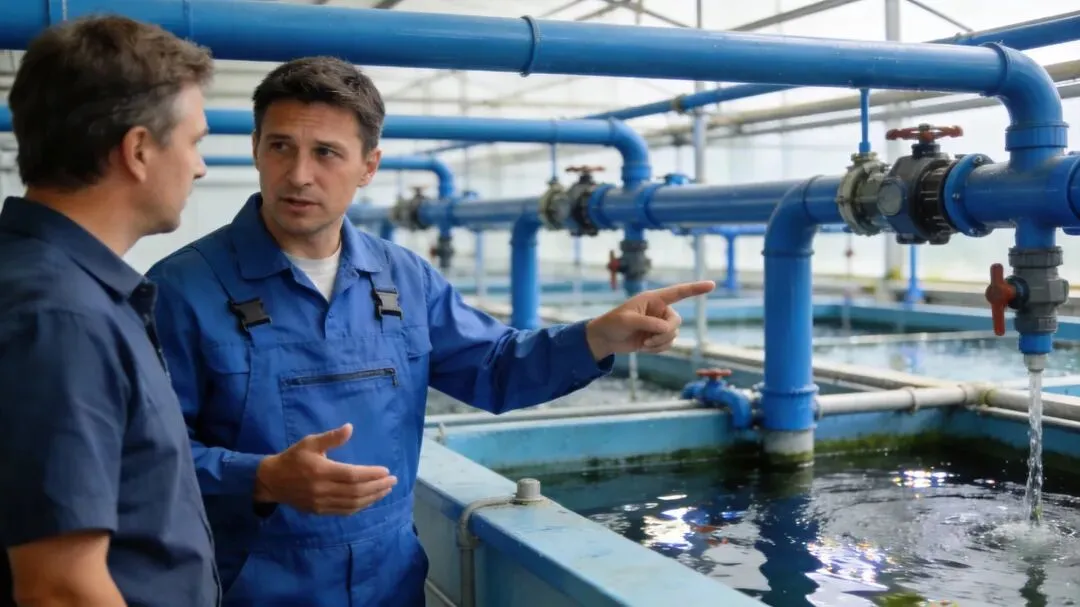
A farm that arrives with two to four weeks of records and a farm that says only "I want a recirculating system" walk away with two different plans.
05 | Closing
Australia's A$10 million is a reminder to the whole industry: the next threshold is not who owns the most advanced equipment, but who keeps a clear record of what happens each day.
AI is a tool. Sensors are tools. The real starting point is that record book of your own — treatment capacity has to follow the real load before stability means anything.


