
Zhejiang University Visits Small Boss for MBBR Biofiltration Joint R and D
Here is something you do not see every day — a top-tier Chinese university research lab and a 30-year specialty plastics manufacturer sitting in the same room, debating biofilm attachment rates and aeration efficiency like they have been partners for years.
That was the scene on July 10 2026, when Prof Pang Hongshuai brought his Smart Fishery Research Center team from Zhejiang University to Tongxiang. Their destination: Small Boss Specialty Plastics, a company better known for PVC profiles than aquaculture — until you look closer.
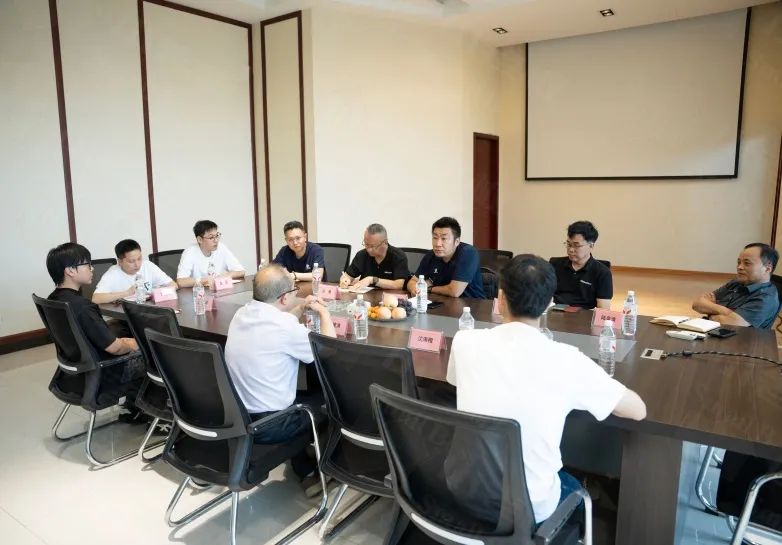 Prof Pang Hongshuai (center) with Small Boss Chairman Shen Jianqing and the joint technical team
Why This Meeting Matters
Recirculating aquaculture is not a new idea. China has been pushing factory-based RAS for years. The bottleneck has never been the concept — it is the biofiltration. You can build tanks and pipes anywhere. But keeping water chemistry stable at scale, with real fish and real money on the line? That is where things get tricky.
Prof Pang laid it out plainly during the symposium: the industry needs biofilter media that are not just "good enough" but engineered for specific operating conditions. Different species, different stocking densities, different water temperatures — all of these change what "optimal" means.
Small Boss happened to have spent years working on exactly that. Their MBBR lab is not a side project. It has dedicated engineers, pilot-scale testing rigs, and a track record of supplying biofiltration systems to projects in over 100 countries. The fit was almost too obvious.
"What struck me," one attendee noted afterward, "was how quickly the conversation moved from introductions to real technical detail. Within 20 minutes they were discussing specific surface area optimization and fluidization patterns. That does not happen unless both sides know their stuff."
Five Problems That Keep Coming Up
Chairman Shen Jianqing did something unusual for a factory visit. Instead of running through a polished corporate presentation, he put the industry's ugliest problems on the table and walked through how Small Boss had been tackling each one.
Media Accumulation
Traditional MBBR media tend to clump in corners. Small Boss redesigned the geometry so carriers stay evenly distributed across the tank — no dead zones, no wasted volume.
Slow Biofilm Formation
A new system can take weeks to mature. Their surface treatment technology cuts that startup window significantly, which matters a lot when you have fish waiting.
Low Treatment Efficiency
Higher specific surface area does not automatically mean better treatment. The real trick is multi-stage coupling — something their engineering team has been refining for years.
High Aeration Energy
Aeration eats up 40 to 60 percent of a RAS facility's energy bill. Their upgraded retention screen system reduces the air volume needed without sacrificing mixing.
Maintenance Headaches
Nobody wants to shut down production to clean biofilter media. Modular design means individual sections can be serviced without draining the whole system.
Shen's closing point was blunt: Small Boss is not just selling plastic media anymore. They are moving toward being a system-level partner — design, equipment, commissioning support. The ZJU team took notes.
What Farmers Actually Want
One of the more interesting parts of the day came from the sales team — Ding Shiwen, Shen Fuqiang, and Yu Lei. These are the people who take calls from frustrated farm managers at 8 PM. They know what the market is asking for because they hear it every week.
The list was surprisingly consistent across different regions and farm sizes:
| System Stability | The number one ask. Farmers need to know their water quality will not crash at 3 AM. |
| Remote Monitoring | Younger operators expect to check their systems from a phone. Not a "nice to have" anymore. |
| Energy Costs | Electricity is often the second biggest line item after feed. Every kilowatt-hour saved goes straight to the bottom line. |
| Low Maintenance | Equipment that needs constant attention defeats the purpose of automation. |
Ding summed it up in a way that resonated with the ZJU researchers: "They are not asking us for filter media. They are asking us to take a problem off their plate." That framing — moving from component supplier to solution provider — became a recurring theme for the rest of the day.
When Engineers Sit Down Together
The afternoon technical session was where things got specific. Dr Qian Yang, the center's chief scientist for recirculating aquaculture, and Engineer Zhang Yong sat across the table from Small Boss MBBR engineers Yin Yijie and Pan Feng. Four people, five core topics, and a whiteboard that filled up fast.
 Dr Qian Yang and Engineer Zhang Yong in technical discussion with Small Boss MBBR lab team
Biofilter Media Optimization — The conversation here was not about "bigger surface area." It was about the trade-off between specific surface area and fluidization behavior. Too much surface area can mean poor mixing. There is a sweet spot, and it varies by application.
Aeration and Retention — Dr Qian pushed hard on energy efficiency numbers. The Small Boss team presented data from their upgraded retention screen system, showing measurable reductions in air volume requirements without loss of treatment performance.
System Energy Modeling — This one got the whiteboard treatment. The ZJU side wanted to build a full-process energy model. Small Boss had the operational data to feed it. Together they sketched out a framework for tracking energy from inlet to outlet.
Dynamic Control — Instead of running biofilters at fixed settings 24/7, the idea is to adjust based on real-time water quality data. The technology exists. The challenge is making it reliable and affordable at commercial scale.
Project Integration — Going from lab validation to a working commercial system is where most collaborations stall. Both sides agreed to focus on a concrete demonstration project as the next step — something real, with measurable outcomes.
By the end of the session, the outline of a preliminary cooperation agreement was on the table: joint R and D on high-efficiency intelligent biofiltration, with Small Boss providing the manufacturing and engineering backbone and ZJU contributing research depth and testing infrastructure.
Walking Through the Lab
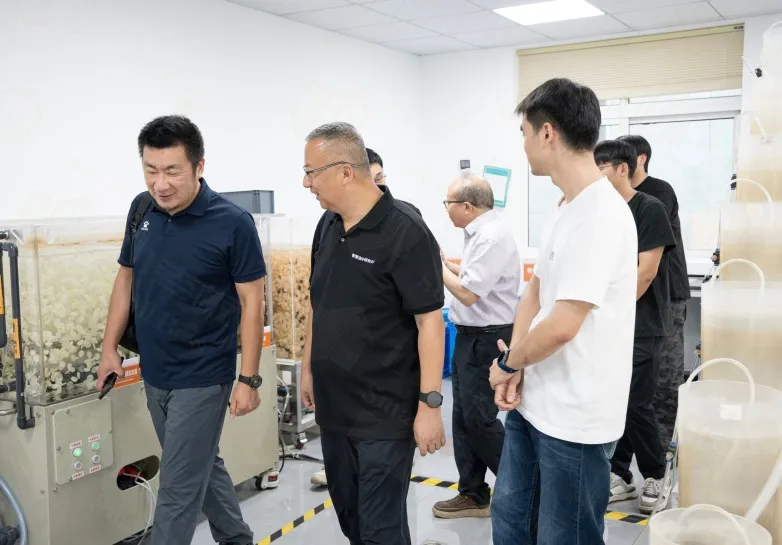
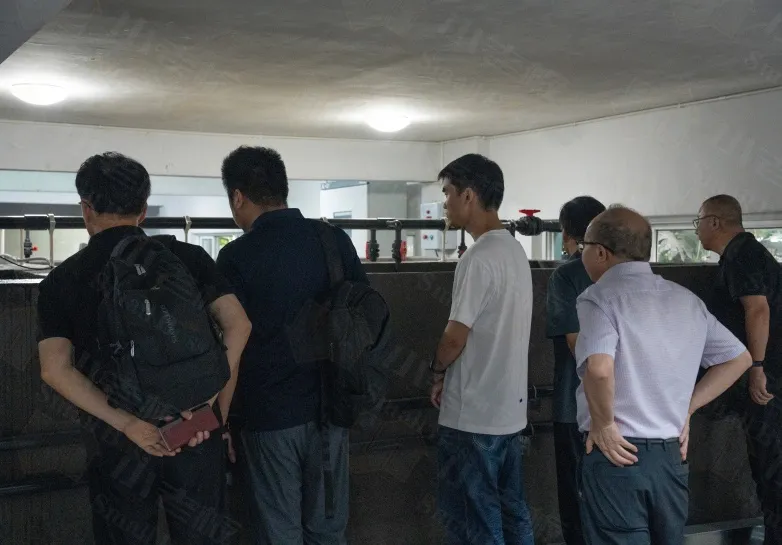
After the meeting, lab technician Wang Yu took the ZJU team through Small Boss's R and D facility. For researchers who spend their days in university labs, seeing a working industrial-scale pilot system is always valuable — and sometimes humbling. Theory meets reality in the piping and pump curves.
 Lab technician Wang Yu demonstrates pilot-scale MBBR testing systems to the ZJU delegation
The visitors spent considerable time at the pilot-scale testing rigs — not just looking, but asking detailed questions about flow rates, sampling protocols, and how the team handles data logging. The kind of questions that suggest future collaboration, not just polite interest.
What This Means for the Industry
Industry-academia collaborations in China's aquaculture sector are not rare. What makes this one worth watching is the alignment of incentives. ZJU needs manufacturing partners who can scale research into commercial products. Small Boss needs research depth to move from component supplier to system provider. Both sides have something the other genuinely needs.
If the joint R and D program delivers — and the preliminary agreement suggests both sides are serious — the result could be biofiltration systems that are not just "good for a Chinese manufacturer" but competitive with the best available globally. For an industry where water treatment is often the difference between profit and loss, that is a story worth following.
About Tongxiang Small Boss Special Plastic Products Co Ltd
With over 30 years in specialty plastics manufacturing, Small Boss has built a complete MBBR infrastructure — from R and D and pilot testing through to mass production. Their biofiltration product line spans biofilter media, retention screens, and aeration systems, serving recirculating aquaculture and industrial wastewater projects across more than 100 countries.
The company holds 137 national patents and is recognized as a National "Specialized and Sophisticated Little Giant" enterprise by China's Ministry of Industry and Information Technology.
Explore: MBBR Products · Made-in-China · Alibaba
Interested in MBBR biofiltration solutions?
Talk to our engineering team about your project requirements
Marc Ding · Sales Manager · +86 15868365820 · Contact Us
TDK: Title: Zhejiang University Visits Small Boss for MBBR Biofiltration Joint R and D Description: A closer look at what happens when China's top aquaculture research team meets a 30-year specialty plastics manufacturer. The ZJU-Small Boss MBBR collaboration could reshape recirculating aquaculture standards. Keywords: Zhejiang University, Small Boss, MBBR biofiltration, recirculating aquaculture, RAS, biofilter media, industry-academia collaboration


