
Nitrification and Denitrification
Nitrification/denitrification is the most common biological process for removing nitrogenous substances from wastewater. Indeed, the MBBR biological treatment is used to clean nitrogen-rich wastewater. Most treatment systems rely on microbial activity to eliminate undesirable nitrogen and mineral compounds:
· Ammonia
· Nitrites
· Nitrates
To eliminate these compounds, bacteria must follow a two-step process.
Nitrification Step
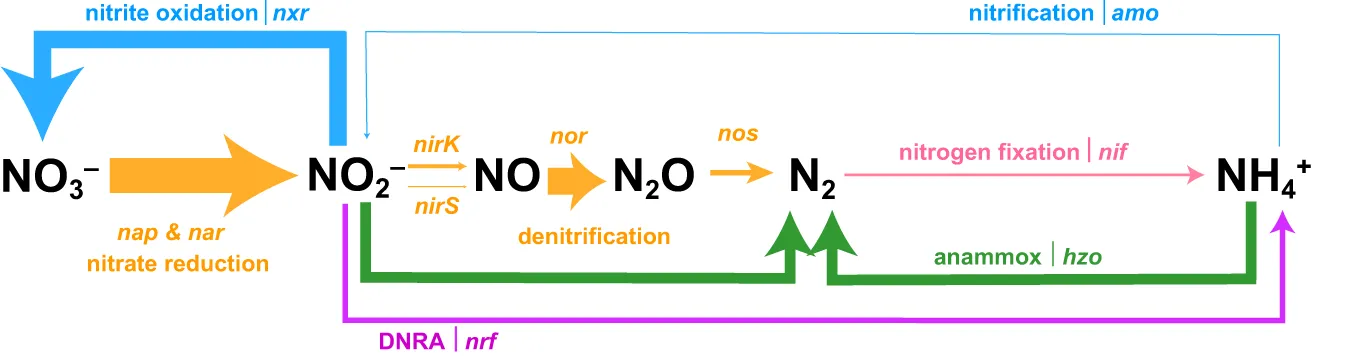
Nitrification is the first step in the biological treatment of nitrogen. It is carried out by aerobic bacteria that oxidize ammonia (NH4+) into nitrite (NO2-) and then into nitrate (NO3-). This reaction is catalyzed by aerobic bacteria such as Nitrosomonas europaea and Nitrobacter hamburgensis.
During this phase, bacteria oxidize ammonium to nitrite under aerobic conditions.
Nitrification occurs in two successive steps:
1. Oxidation of ammonia to nitrite: Bacteria of the genus Nitrosomonas oxidize ammonia to nitrite under aerobic conditions. This step is crucial as it removes ammonia, a toxic pollutant for aquatic environments.
2. Oxidation of nitrite to nitrate: Bacteria of the genus Nitrobacter then oxidize nitrite to nitrate. This reaction also requires aerobic conditions and a sufficient amount of dissolved oxygen.
Denitrification Step
Denitrification is the second step in the biological treatment of nitrogen. It involves converting nitrates into dinitrogen (N2), a harmless gas. This reaction is catalyzed by anaerobic bacteria such as Paracoccus denitrificans.
In the absence of oxygen, microbes use nitrate from ammonium to release electrons.
In fact, dinitrogen is harmless because it makes up about 80% of the air we breathe. The nitrification/denitrification processes naturally eliminate ammonium and nitrate. These compounds contribute to the pollution of natural waters without causing harm to health or the planet.
Denitrification occurs in two steps:
1. Reduction of nitrates to nitrite: Bacteria reduce nitrates to nitrite under anaerobic conditions. This step is important because it removes nitrates, which can be toxic to aquatic organisms.
2. Reduction of nitrite to dinitrogen: Bacteria reduce nitrite to dinitrogen. This reaction is also anaerobic and requires a complete absence of oxygen in the water.
Importance of Denitrification
Denitrification is essential to completely eliminate nitrogen from wastewater. It helps recover the alkalinity lost during nitrification and reduce nitrate concentrations in treated water. Denitrification is also important for preserving the quality of drinking water and the environment.
To ensure good denitrification, certain conditions must be met:
· Absence of oxygen: Anaerobic bacteria require a total absence of oxygen to function.
· Presence of nitrates: Anaerobic bacteria need nitrates to feed on.
· Presence of denitrifying bacteria: Anaerobic bacteria must be present in the environment to catalyze denitrification.
· Constant temperature: The temperature must be constant to allow the bacteria to develop.


